
11 min read20 September
Entrepreneur, papal knight and now Liberal Democrat backbencher Angus MacDonald tells Sienna Rodgers about his colourful life and why Westminster needs more business brains
Angus MacDonald is described as a “rare politician” by a colleague who compares him, approvingly, to a red squirrel.
Papal knight, self-described Gladstonian liberal, Sandhurst graduate – it might be easy to cast the 63-year-old as an anachronistic holdout against the grey tide of modernity in his Highland fastness. But MacDonald is also a highly successful entrepreneur, a multi-millionaire who has set up and sold a string of businesses and brings to Parliament a sharp eye for the market.
He confesses he was shocked by how many MPs end up at Westminster after a career within the state’s fold, untroubled by the bottom line when he beat the SNP to represent Inverness, Skye and West Ross-shire, part of which was once Charles Kennedy’s patch.
While expressing relief that Ed Davey has “stopped the stunts” (although this is contradicted by the leader in his own House interview), MacDonald is not especially critical of his party’s figurehead. He does, however, think the Liberal Democrats need to expand their offer.
“We need to broaden our range. Everybody knows we’re the party of health and social care, but I think we need to be the party of small business, and the party of education. If we had a three-legged stool, we would be a real contender to be a party in power.”
“But my opinion is to be taken lightly because I don’t have a clue what I’m talking about,” he adds, in what The House comes to recognise is typical playful – and disarming – self-effacement.
MacDonald, it is fair to say, is full of surprises, cheerfully admitting for example that he is a former donor to the Conservatives and Labour. The MP says this was in aid of resisting Scottish independence, though his attraction to the Conservatives went deeper than that.
“My father was a Conservative. But Boris Johnson and Liz Truss knocked any affection for the Conservative Party I might have had,” he says. Could that change again one day, if the Tories were to move back to the centre? “I would say I was a compassionate capitalist, and I don’t think the Conservatives have that compassion.”
So, what does MacDonald want to achieve in politics? His answer is immediate and comes with a printed copy of a report he has just written, titled Remote Scotland: Spiralling Towards Unviability?.
“Those living in remote Scotland face an unparalleled, difficult challenge of almost survival,” he explains. “Costs are 30 per cent higher. Incomes are 10 per cent lower. Public services are much less good, and the stopping of EU structural funds has been catastrophic. We are now generating the electricity needed for Great Britain from the Highlands, but it is offering minimal jobs, no legacy housing and almost no community benefit.”
High housing, energy and food costs, health and social care deserts, a lack of childcare, poor transport and digital connectivity are all analysed and assessed as “serious” or “critical” in his paper, complete with constituent testimonies. Current government policy, MacDonald argues, simply does not cater for this area as one of Europe’s most sparsely populated regions. The demographic crisis is particularly acute here and getting worse.
“I would say the West Highlands has the most severe demographic problem of the whole United Kingdom. Many of the schools have half the school roll they had 20 years ago.
Obviously, people are having less children, but we have young, dynamic families leaving the area because of the education offering and the fact you get paid less and the costs are higher.”
Does he have any thoughts on the challenge of explaining our declining birth rates? “As you’ve discovered, I’m not very bright,” he replies, “so I never have the next thought.” He suspects social media is a key culprit.
MacDonald is especially interested in economic policy, for example lobbying to raise the VAT registration threshold for small businesses, though admits he has not got very far with this.
“I would say what’s most shocked me is the complete lack of business knowledge and interest throughout the whole of Parliament, and that the people who are coming into Parliament are very often people who have been in the public sector, or charities, or consultancy, or have been just in politics,” he complains.
“I’m very frustrated because I go around seeing everybody about my policies and nobody’s interested.”
What is perhaps more attention-grabbing about MacDonald’s politics is his approach to cultural issues. On the face of it, one might call him a social conservative, though he prefers to characterise himself as a Gladstonian liberal. He is also, notably, a Catholic – to the extent he has been awarded a papal knighthood, for service to the church – which must have informed his opposition to assisted dying.
“I think 11 of the 72 Lib Dems voted against assisted dying.” (It was 11 at Second Reading and 15 at Third.) “I hope there’ll be more than that next time round. Politically, it’s enormously useful for me – my voters are thrilled with my moral stance,” he says.
While some advocates of Kim Leadbeater’s assisted dying bill were critical of those who objected on the basis of faith, others pointed out that we all get our moral compass from somewhere.
“I suppose I get guidance on a belief that politicians should have a moral compass, and I think if you’re active in faith, you’re more likely to have a moral compass. That’s going to rile a few people up,” MacDonald smiles.
He has certainly angered some Lib Dem members online with his dissent on trans issues, having made clear he rejects self-identification on gender and is concerned by the puberty blockers trial.
“I have had absolutely no pushback on my beliefs from anybody,” he says, referring to Lib Dem MPs, “even though I know that three or four of them are 180 degrees opposite of all my views.”
“The great thing about liberalism is it’s quite a broad church. The fact is, I’ll vote against the whip on things I care about. I made it very clear when I joined that I wouldn’t be whipped on moral issues,” he adds.
London-born MacDonald was raised in a famous Highlands climbers’ pub, Clachaig Inn, which his parents ran. “It was a great place to grow up,” he recalls. “It was back in the days when pubs were very vibrant places, so we would sometimes have 300 people in the bar. For a rural pub, it was humming.”
He started serving pints aged 10, he says. And drinking them? “Surreptitiously or legally?” the MP replies. He cannot remember but does confess to “minesweeping” – finishing abandoned drinks.
“I’m very frustrated because I go around seeing everybody about my policies and nobody’s interested”
His parents met in New York, where his father was working in the whisky industry, before his American mother was brought back to the Highlands – a “huge shock” given the wet weather and isolation. “She lasted 30 years, which is 29 and a half years longer than anybody thought it would last,” before going back to the States.
“I went to a Catholic boarding school down south in order to get some discipline knocked into me, and then my parents ran out of money, so they moved us to a day school in Edinburgh, Edinburgh Academy,” says the MP, enthusiastically tucking into his ice cream (it is a hot day in Westminster – though apparently, he eats it every day of the year).
“But a) I didn’t do well academically, and b) I met a girl, and I pursued her to Uruguay. She was Uruguayan, but she was doing a one-year exchange in Scotland. I thought, ‘She’s the one for me.’”
Leaving aged just 16, he spent a year in South America – until her family “made it clear that I should move on”. In the meantime, his entrepreneurial ways had begun: via a bus venture for tourists headed for Machu Picchu in Peru, he made “a fair bit of money”.
“I came back on the QE2, the liner. My father met me in Southampton, and he said, ‘It’s the army for you, laddie.’ I went to Sandhurst, extraordinarily, then did a short service commission, which was the making of me.”
MacDonald repeatedly emphasises just how lacking he was in academic ability – a surprise to him, given his father was an Oxford scholar. “He’s brilliantly intelligent. He was never a money-maker. He couldn’t quite understand why his children were not academic, and I don’t know the answer. But I’ve had many MBAs and PhDs work for me, and I seem to have been able to hold my own.”
So, off the young MacDonald went to the Falklands, post-ceasefire (“similar to the Highlands: very remote, tens of thousands of acres of barren land, very strong winds – I don’t remember being unhappy there at all”), then Northern Ireland. He was 18; the youngest in his platoon of 30.
“You grow up very quickly. You have to gain respect; you have to earn respect. It doesn’t come with the job. I think it was a good lesson in hard work, humility, working well with people, getting results without shouting. It’s a very consensual relationship between the officer, the sergeant and the men.”
MacDonald soon left the army – again, to pursue romance, having met his now-wife in Northern Ireland.
“I had already decided that the girl I was with was the one for me. She actually decided I was not. There’s a bit of a theme coming here! She did end up marrying me, but it took quite a while.
“I always knew that the army – it’s a difficult family life. You’re away from home a great deal, and you live in poor-quality housing, in a part of the world where your family don’t necessarily want to be. Also, I knew I wanted to go and work in the Alps as a ski guide,” he says.
“I did that for a winter and met a chap in a chairlift who offered me a job in finance. Obviously, you just keep going round until they offer you a job and can’t get off.”
The role kindled in him a love of business. Since then, MacDonald has founded multiple companies – including a data product for investment managers, a newspaper and a recycling firm – and sold them for a cumulative £150m.
MacDonald’s sons Archie, Jack and Jamie have followed the same entrepreneurial path (soap, kombucha and the family business of supplying spare parts for wind turbines, respectively). A fourth son, Donald, is the exception; he is “one of the Neets”, struggling to work in finance after gaining a 2.1 in theology at Edinburgh, so has just requalified.
“Hopefully, he’ll get a job now. But the big alarm to me is so many of our kids are studying a subject which will not help them get jobs in Britain, and I think we have to wake up and smell the bacon,” says MacDonald. Did he advise Donald against reading theology? “I’ve always made it clear to him that he’s mad for studying that.”
The MP is most proud of his philanthropic projects. In the 90s, he created the ‘Caledonian Challenge’, a 54-mile sponsored walk from Fort William to Loch Lomond that raised £14m over 20 years, for which he was awarded an OBE.
More recently, he read an article about how to transform a market town and spotted an opportunity to enhance Fort William, which struggles despite being a tourist centre (mostly a draw for hikers; also for Harry Potter fans who want to visit the nearby Glenfinnan Viaduct, which carries the Hogwarts Express in the films).
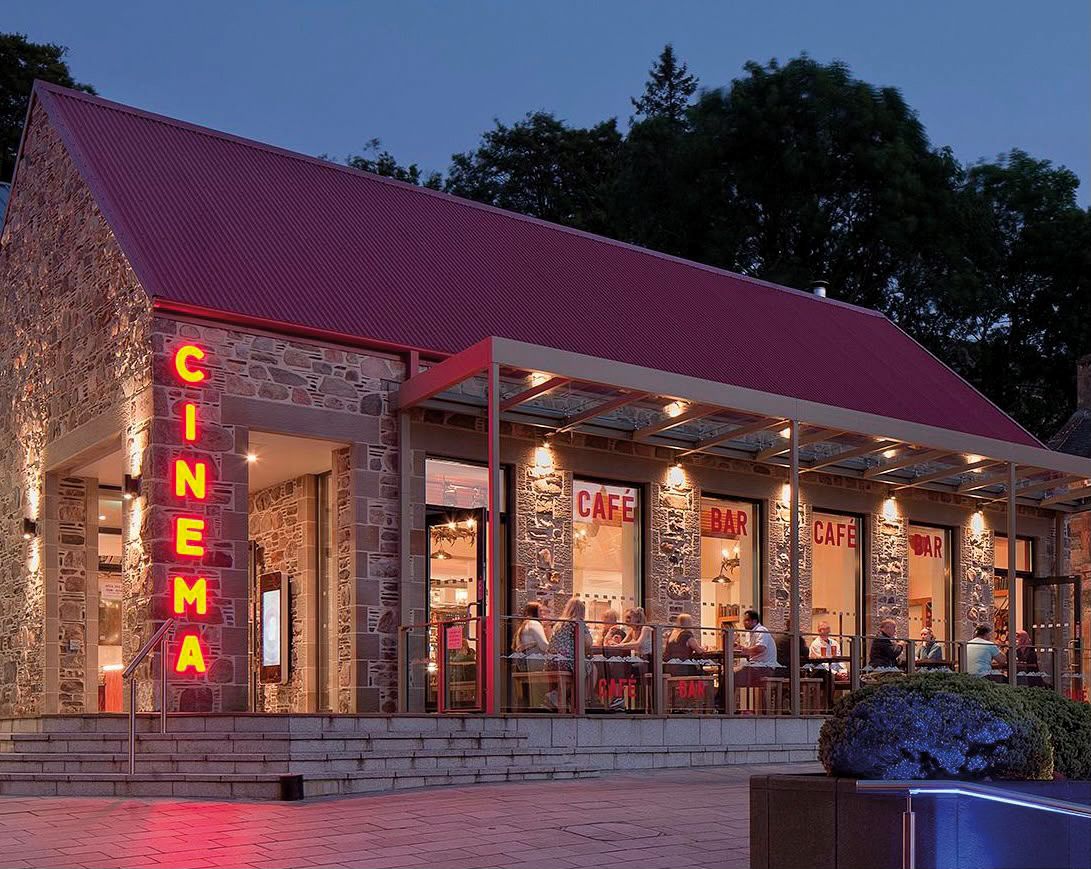
It recommended a town centre cinema with a restaurant – so, that is precisely what MacDonald created. He bought the old town hall, put a 100-seat restaurant and two-screen cinema in it, and parked a red Lotus sports car inside for good measure. It is now award-winning and owned by the community.
As an MP in the Highlands, MacDonald has a difficult schedule. He leaves home on a Sunday afternoon to catch the sleeper train down for parliamentary business starting a day later, often can only make it home for one night a week, and travels up to four hours to work at the far end of his constituency even when he is there. “I wouldn’t say my wife is a fan.”
Despite this, and his reflection that “in retrospect, I would’ve been very happy to be an MSP”, he is happy with the decision to take a seat in Westminster.
“Quite a lot of my friends are 65 and bored and not contributing and not fulfilled. They haven’t helped other people. They’ve done well, clipped the coupon and not benefited,” he says.
“I believe very strongly that if you’ve been lucky in life, you should give back. It would have been easy for me to continue my life of comfort in the Highlands of Scotland, writing novels and enjoying the social buzz, but I don’t think that is me.
“Although I find the commitment to Westminster a real challenge, I enjoy it a great deal, and do feel that people who can make change should do it rather than take the easy option.”